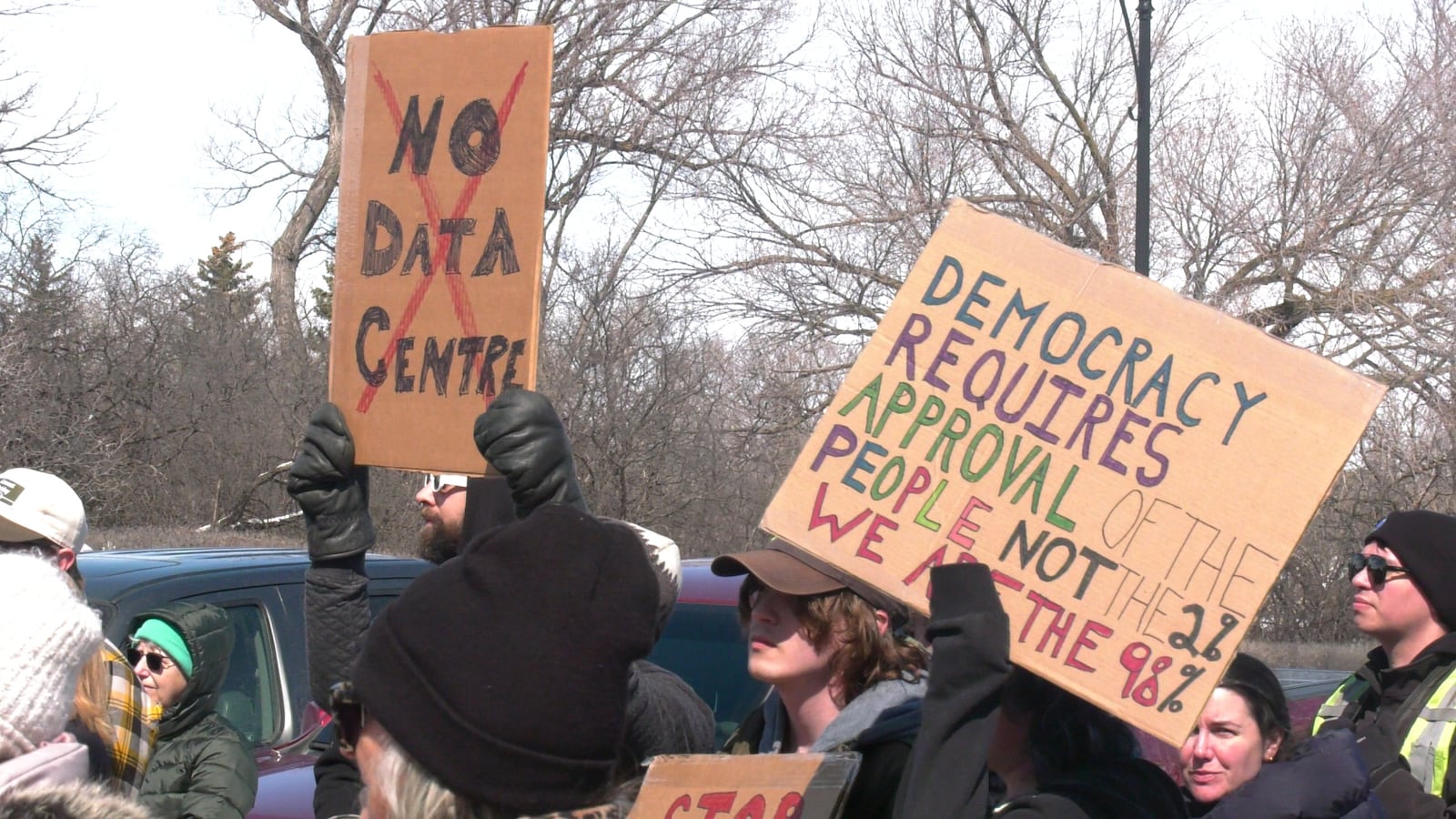
Ahead of a key meeting on Monday, Regina citizens took to the Saskatchewan legislative building to protest the continuation of the new AI Data Centre on Saturday. Bell Canada is set to construct Canada’s largest data centre on a 160-acre plot of land in the rural municipality of Sherwood, just south of Regina’s Sask. Polytech campus. The facility, which will cost approximately $1.7 billion to construct, represents a $12 billion total investment into the province. Organizers of the protest continue to echo the lack of transparency from the RM of Sherwood and Bell Canada. “The public is being left out of this decision,” said Jay-Jay Bigsky, an organizer. “Why are we supporting such a harmful tool? What is the end goal here? Whose pockets are being filled? What impact is this going to have on our environment?” “Me and my family are extremely, categorically 100% anti AI as a principle,” said one member in the crowd. “We work in education and we’re very worried about the way it’s being forced on education systems and what adopting it is doing to people in terms of critical thinking skills to their ability to evaluate information to their brain power.” Hundreds of people took to the legislative building, with many signs saying “protect the prairies”, “humans raging against this machine” and “democracy requires approval of the people, not the 2%, we are the 98%”, to name a few. Last month, Bigsky was one of around 100 citizens who wrote hand-written letters to the RM of Sherwood, Bell Canada and city councillors. “You can ignore phone calls; you can ignore emails. But it’s really hard to ignore a letter when it comes in front of you,” he said. “It’s really hard to ignore a group of beautiful people coming together for a beautiful, united cause.” As for city council, councillor Shanon Zachidniak believes that the continuation of the data centre should be tabled, for the time being. “I think that also speaks to the point, ‘Oh, hang on a second, we haven’t done this before,’” she said. “Let’s make sure as well, on our end of the city of Regina, that we have the information and the procedures in place to allow us to quickly assess this.” Ahead of the RM of Sherwood meeting on Monday evening, Zachidniak said that she was not able to register to speak because she couldn’t find a place to register. As part of her tabled stance, she would like a decision to be made “by democratically elected councillors”, which is set to take place this year. Last month, four of seven councilors, including the reeve resigned. Those positions were filled on an interim basis on Tuesday. “If this is truly a wonderful opportunity for our area, then there’s nothing to lose by slowing things down and ensuring that everybody has the appropriate information to make an informed decision,” said Zachidniak. To-be-located just south of the city, protestors cited noise and pollution as major concerns. “We know that generative AI and AI models are used for a lot of very vicious things,” said Bigsky. “If that’s something that we’re housing here in Saskatchewan and poisoning the rest of the world with, it’s not something that we need in Saskatchewan.” Bigsky also said that he’s curious to see how much local hiring they will do on specialized heavy equipment during the construction phase. Planning documents published earlier this month revealed the intended layout for the facility, along with preventative measures that will be taken to manage noise, light, and air pollution. According to the documents, the facility will utilize air-cooled, closed-loop chilling technology – that “does not consume or evaporate water to reject heat to the atmosphere.” Once the system is filled during commissioning, it will remain entirely sealed. As a result, the facility’s water connection to the municipality will be sized to support “standard domestic use and essential fire protection requirements.” The project is expected to support more than 800 jobs during construction, with 80 full-time positions being created once the campus is up and running. Construction is scheduled to start this spring, with the facility coming online in stages, beginning in the first half of 2027.
|